China
We decided that after travelling extensively through Europe, Middle East and South America, we had to see one of the oldest continuous civilizations in the world, China. I started preparations over 6 months before our trip, trying to find the right travel agent. Due to language barriers, I was less confident of a DIY type trip through the country. We settled on Sylvia Gan (
Facebook page) from Easytour China, who turned out to be fantastic!
Our first stop was Beijing. We landed there on the last day of the Golden week holiday, which sees the largest movement of people in the world (when everyone heads to their hometown; this involves 600 million people!). Luckily we were at the back end of this holiday. Our hotel was the Regent Grand (
weblink), one of the best hotels in Beijing. It was just off the Wangfujiang Street, which is where the high end car and luxury goods showrooms are. It reminded me of Rodeo Drive in Los Angeles.
 |
| Hotel Regent at night |
 |
| High end car showrooms around our hotel |
 |
| Lillian's favourite person in China - we bought designer bags from her in the Silk Market |
 |
| Interesting snacks on a stick |
On our first morning, we headed to the Tiananmen Square. It is the largest Square in the world, ahead of the Red Square in Moscow, and the Zocalo in Mexico City. It also borders the Chinese Parliament, and the Forbidden City.
 |
| Chinese Parliament at Tiananmen Square |
 |
| Patriotic Chinese girl |

Our next stop was the Forbidden City, the center of the
Chinese Empire for a thousand years. To put things in perspective, the Chinese
empires were three times larger than Rome in population and economic
size. The Forbidden City was the Chinese imperial palace from the Ming dynasty to the end of the Qing
dynasty—the years 1420 to 1912. It
is located in the centre of Beijing, China, and now houses the Palace Museum. It served as the home of emperors and their households as well as the
ceremonial and political centre of Chinese government for almost 500 years.
Built in 1406 to 1420, the
complex consists of 980 buildings and covers 72 ha (180 acres). The
palace complex exemplifies traditional Chinese palatial
architecture, and has influenced cultural and architectural developments
in East Asia and elsewhere. The Forbidden City was declared a World
Heritage Site in 1987, and is listed by UNESCO as the
largest collection of preserved ancient wooden structures in the world.
 |
| The northern ramp, behind the Hall of Preserving Harmony, is carved from a single piece of stone 16.57 metres (54.4 ft) long, 3.07 metres (10.1 ft) wide, and 1.7 metres (5.6 ft) thick. It weighs some 200 tonnes and is the largest such carving in China. |
 |
| Forbidden City, Beijing |
.
 |
| Palace room, Forbidden City |
 |
| Cool looking Tuk tuk/autorickshaw |
 |
| Temple of Heaven |
 |
| Qing dynasty guardian male lion (ball on right side) |
 |
| Shi - lion in Chinese |
 |
| Chinese Parliament |
 |
| Bedroom of the Empress |
 |
| The Gate of Divine Might, the northern gate. The lower tablet reads "The Palace Museum" |
Our
next trip was to the Great Wall of China. Before we reached there, our first
stop was to the Ming Dynasty museum. It was underground, and called the
Dingling Tomb. The siting of the Ming dynasty imperial tombs
was carefully chosen according to Feng Shui (geomancy)
principles. According to these, bad spirits and evil winds descending from the
North must be deflected; therefore, an arc-shaped valley area at the foot of
the Jundu Mountains, north of Beijing, was selected. This 40 square
kilometer area—enclosed by the mountains in a pristine, quiet valley full of
dark earth, tranquil water and other necessities as per Feng Shui—would become
the necropolis of the Ming dynasty.
 |
| Dingling Tomb |
 |
| Ming Throne |
 |
| Ming Crown |
 |
| Gold artifacts |
Dingling ( literally: "Tomb of Stability"), one of the tombs at the Thirteen Tombs of the Ming Dynasty site, is the tomb of the Wanli Emperor. It is the only Ming tomb to have been excavated. It also remains the only intact imperial tomb, of any era, to have been excavated since the founding of the People's Republic of China, a situation that is almost a direct result of the fate that befell Dingling and its contents after the excavation.
The next stop was the incredible Great Wall of China. The Great Wall of China is a series of fortifications made of stone, brick, tamped earth, wood, and other materials, generally built along an east-to-west line across the historical northern borders of China to protect the Chinese states and empires against the raids and invasions of the various nomadic groups of the Eurasian Steppe. Several walls were being built as early as the 7th century bc;these, later joined together and made bigger and stronger, are now collectively referred to as the Great Wall. Especially famous is the wall built 220–206 bc by Qin Shihuang, the first Emperor of China. Little of that wall remains. Since then, the Great Wall has on and off been rebuilt, maintained, and enhanced; the majority of the existing wall is from the Ming Dynasty
 |
| Great Wall snaking through the country |
 |
| Wide enough for a truck to drive through |
The
Great Wall of China is a series of
fortifications made of stone, brick, tamped earth, wood, and other materials, generally built along an east-to-west line across the historical northern borders of China to protect the Chinese states and
empires against the raids and invasions of the various nomadic groups of the Eurasian Steppe. Several walls were being built as early as the 7th century
bc;these, later joined together and made bigger and stronger, are now collectively referred to as the Great Wall. Especially famous is the wall built 220–206
bc by Qin Shihuang, the first Emperor of China. Little of that wall remains. Since then, the Great Wall has on and off been rebuilt, maintained, and enhanced; the majority of the existing wall is from the Ming Dynasty.
Other purposes of the Great Wall have included
border controls, allowing the imposition of duties on goods transported along the
Silk Road, regulation or encouragement of trade and the control of immigration and emigration. Furthermore, the defensive characteristics of the Great Wall were enhanced by the construction of watch towers, troop barracks, garrison stations, signaling capabilities through the means of smoke or fire, and the fact that the path of the Great Wall also served as a transportation corridor.
The Great Wall stretches from Dandong in the east, to Lop Lake in the west, along an arc that roughly delineates the southern edge of Inner Mongolia. A comprehensive archaeological survey, using advanced technologies, has concluded that the Ming walls measure 8,850 km (5,500 mi). This is made up of 6,259 km (3,889 mi) sections of actual wall, 359 km (223 mi) of trenches and 2,232 km (1,387 mi) of natural defensive barriers such as hills and rivers. Another archaeological survey found that the entire wall with all of its branches measure out to be 21,196 km (13,171 mi)
 |
| Kung Pao chicken and Chillies with Beans |
 |
| Xian City Walls |
Our highlight visit was to the Terracotta warriors. Now, I had heard about them, but never expected the sheer size of the place. It stretched to at least the length of 2 football stadiums. Each soldier had been carved in the likeness of an actual person at that time, so it wasn't a case of mass manufacturing.
 |
| Modern Day Terracota warrior with sunglasses and multiple hands! |
 |
| The size of two football stadiums - and this was only one section! |
 |
| Each soldier was crafted in the likeness of an actual person! |
 |
| Soldier in a kneeling pose |
When I was a kid in India, we studied about Xuanzang (
weblink)., who visited India during the reign of King Harsha. Most of our records of that period are from the writing of this monk. He came to India to study Buddhism. After many years, he departed with thousands of Sanskrit texts, which he translated to Mandarin in Xian. He also wrote the great Chinese epic - Journey of the Monkey Prince to the Kingdom of the West. In this case, the Monkey Prince was based on the Hindu God Hanuman (
weblink), and the Kingdom to the West was India.
 |
| Wild Goose Pagoda |
 |
| Buddhist Deity |
Our dinner in Xian was an interesting one. We had bookings at the De Fa Chang restaurant (weblink), which was famous for its dumplings. The dumplings were all shaped like little animals. Our guide had made the reservations and placed the order, since very little English was spoken in this place. The taxi ride back was interesting. The tuk tuks refused to go to our hotel unless we were on the right side of the road (ie, they wouldn't take u-turns).
 |
| De Fang Restaurant |
 |
| Dumplings on display - in shape of different animals |
 |
| Duck shaped dumplings |

The next city in our travel was Chengdu. This is the capital of the Sichuan province, which is famed for its spicy food. There is a special type of pepper named after Sichuan, which is famous for the numbing sensation it has.
As soon as we landed, we headed to the Panda research center, which is the biggest one in the world. Lillian was completely taken by the bears, who really are lazing around for most of the time. The animated movie Kung Fu Panda had that part right for sure.
 |
| Lazing Panda |
 |
| Snacks |
 |
| the old meets the new, or China meets the USA! |
 |
| Traditional Tea House in Chengdu |
 |
| Green tea being poured |
The next morning we headed to see the Leshan Buddha. The Leshan Giant Buddha is a 71-metre (233 ft) tall stone statue, built during the Tang Dynasty. It is carved out of a cliff face that lies at the confluence of the Minjiang,Dadu and Qingyi rivers in the southern part of Sichuan province in China, near the city of Leshan. The stone sculpture faces Mount Emei, with the rivers flowing below his feet. It is the largest stone Buddha in the world and it is by far the tallest pre-modern statue in the world.
 |
| Leshan Buddha |
We had some of the spicy food at the Lido Sheraton in Chengdu, which was a fantastic hotel (
weblink). We also met someone named Ajit Khan, who was from Lucknow and a Christian (Amar Akbar Anthony). He was the Food and Beverage Manager, and sat with us since the restaurant was empty (due to Hong Kong rock star performing next to the hotel, which caused the entire hotel to be cordoned off).
Next morning we flew to Lijiang, which was the most pleasant surprise in China. It is close to the Burmese border. It was a cross between a old European town and a Chinese one. Our guide was the best one on the trip - after picking us up in the night from the airport, he took time to take us to a local restaurant and order dinner, even though his family was waiting for him!
 |
| Black Dragon Pool Park |
 |
| Mu's mansion |
 |
| Dog or Lion? Traditional looking Chinese guest house |
 |
| Girl in traditional Naxi dress and me |
 |
| Traditional hot pot |
 |
| Lake in Jade Dragon Snow mountain |
 |
| A Tibetan Buddhist temple - Yufeng Lamasery |
 |
| Old Town, Lijiang |
 |
| Restaurant in Lijiang |
 |
| Old Town Gate, Lijiang |
From Lijiang we headed to Kunming. This a city that will China's gateway to South and South East Asia, in the future. There are multiple train connections, flights and roadways planned to the neighbouring countries. We had only a day's stop here, so we headed to main attraction directly.
In the Kunming Stone Forest tall rocks seem to fall to the ground in the manner of stalagmites, with many looking like petrified trees thereby creating the illusion of a forest made of stone. Since 2007, two parts of the site, the Naigu Stone Forest and Suogeyi Village, have been UNESCO World Heritage Sites as part of the South China Karst..
 |
| Kunming Stone Forest |
That night at the Kunming we stayed at the Green Lake Hotel. We also ended up having the spiciest food in our entire trip (being close to South East Asia, they have those lethal small red chillies which are commonly found in Thai food). I could barely finish half my ground beef and red chilli dish. Lillian had one bite and surrendered.
Early next morning we headed to Guilin. Our guide was a little lady, with the cute nickname of the "Little Bear"! "Guilin" means, "Forest of Sweet Osmanthus", owing to the large number of fragrant Sweet Osmanthus trees located in the city. The city has long been renowned for its scenery of karst topography. Our first stop was the Reed flute Cave.
 |
| Reed Flute Cave, Guilin |
 |
| Twin Pagodas, Guilin |
Our next adventure was a river ride from Guilin to Yangshuo. We were on a river cruise and ended up sitting next to a couple of people who were also from Canada! It was a pleasant journey of 4 hours, well spent chatting with our fellow passengers and also holding a Chinese baby for a photo op for his mother!
 |
| Li River, boats by convoy |
 |
| A neat way to ride on the river |
 |
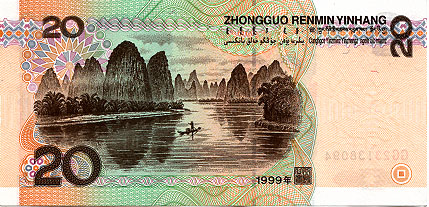
| Legendary image - this scene is shown in the 20 Yuan note (see below) |
Our stay in Yangshuo was quite relaxed. We headed to the West street, where all the tourists and souvenir shops, and bars/restaurants were. We decided to buy the Osmanthus wine, which was famous here. We had a choice of two bottles - one with a snake in it, and one without. Lillian refused to get the snake, which I thought was very cool. Apparently it imparts energy to the wine. But we had to buy the non reptilian version of the wine.
The next morning we headed to the Guilin airport, to catch our flight to Shanghai. Upon landing, our guide, Ren-jo, took us on the high speed Maglev train to the center of the city. The train can run at 400 km per hour (250 miles per hour) but for safety reasons runs at only 320 km/h (200 miles/h). From the city center our driver came to take us to our hotel.
Our first day in Shanghai involved a hectic tour of multiple sites.
 |
| View from the Shanghai Tower |
 |
| The Bund, Shanghai - lots of European architecture |
 |
| Apple-mania in China! |
 |
| The Bund |
 |
| View of Pudong - New Shanghai |
 |
| Yu Garden |
 |
| The Pavilion of Listening to Billows in Yu Garden. |
 |
- Wanhua Chamber ( "Chamber of the Ten Thousand Flowers")
|
 |
| Goldfish in the pond |
 |
| Another spot where China meets the USA |
Our last trip of the tour was to Zhujiajiao (literally: "Zhu Family Corner") is an ancient town located in the Qingpu District of Shanghai. The population of Zhujiajiao is 60,000.
Zhujiajiao is a water town on the outskirts of Shanghai, and was established about 1,700 years ago. Archaeological findings dating back 5,000 years have also been found. 36 stone bridges and numerous rivers line Zhujiajiao, and many ancient buildings still line the riverbanks today.
 |
| In the Venice of the Orient |
 |
| Boats are the main form transport here |
Our train back to Beijing was the high speed Beijing Shanghai line, which travels a distance of over 1500 kms (1000 miles) in about 5.5 hours! Since we got VIP tickets, which costed as much as a plane ride, we got to go before other passengers. The train also had stewardesses, personal TV screens, reclining seats, etc.
One quick night at Beijing and then a flight home! Shih shih China!




No comments:
Post a Comment